tuptime: Track Your System Uptime History
If you've ever wondered about your server's actual reliability over time – not just since the last reboot – you need tuptime. While the standard uptime command only tells you how long your system has been running since it last started, tuptime gives you the full historical picture.


What is tuptime?
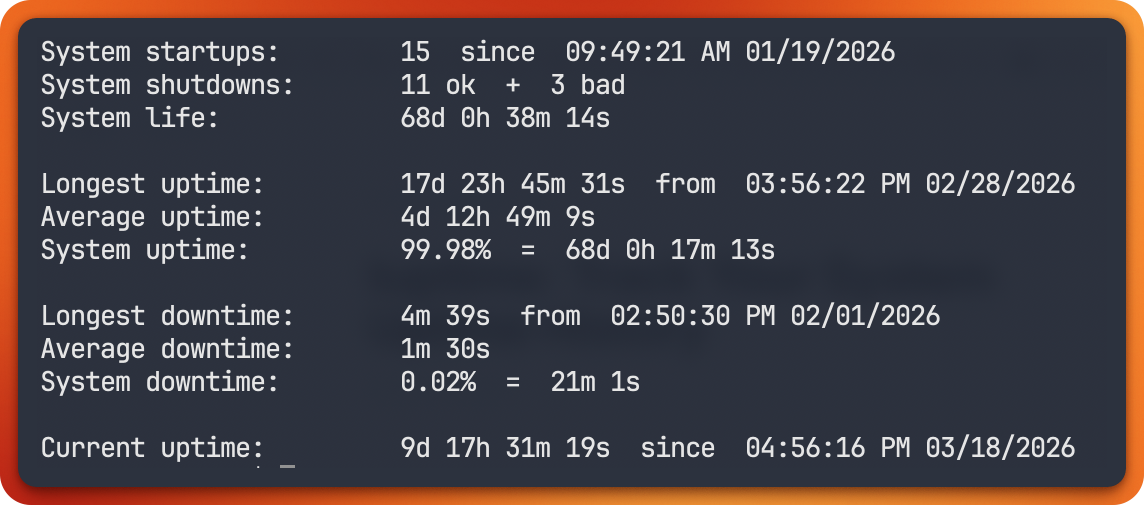
tuptime is a tool that tracks and reports historical and statistical uptime data for your Linux systems. It records every boot and shutdown, building a database of your system's availability over time.
Why It Matters
Understanding your system's uptime patterns is valuable for:
- Reliability metrics – See your actual uptime percentage over weeks, months, or years
- Maintenance planning – Identify patterns in reboots and downtime
- Accountability – Document system availability for SLA compliance
- Curiosity – Find out how many times you've actually rebooted that "always on" server
What You Get
Running tuptime gives you insights like:
- Total system uptime since installation
- Number of boots and average uptime per boot
- Longest and shortest uptimes
- Current uptime ranking compared to historical boots
- Uptime percentage over various time periods
The tool can generate reports in multiple formats and even track multiple systems, making it perfect for homelab enthusiasts managing several servers.
Installation
bash
# Debian/Ubuntu
sudo apt install tuptime

# From source
git clone https://github.com/rfmoz/tuptime.git
cd tuptime
sudo install -m 755 tuptime/src/tuptime /usr/bin/tuptime
After installation, enable it to run at boot and shutdown:
bash
sudo systemctl enable tuptime.service
sudo systemctl start tuptime.service
Quick Example
bash
$ tuptime
System startups:	42 since 2024-01-15 10:23:45
System shutdowns:	41 ok - 0 bad
System uptime:		89.2% - 125 days, 3 hours, 15 minutes
System downtime:	10.8% - 15 days, 2 hours, 45 minutes
Average uptime:		2 days, 23 hours, 54 minutes
For anyone running a homelab or managing servers, tuptime is a lightweight way to truly understand your infrastructure's reliability. It's one of those set-it-and-forget-it tools that quietly builds valuable data in the background.